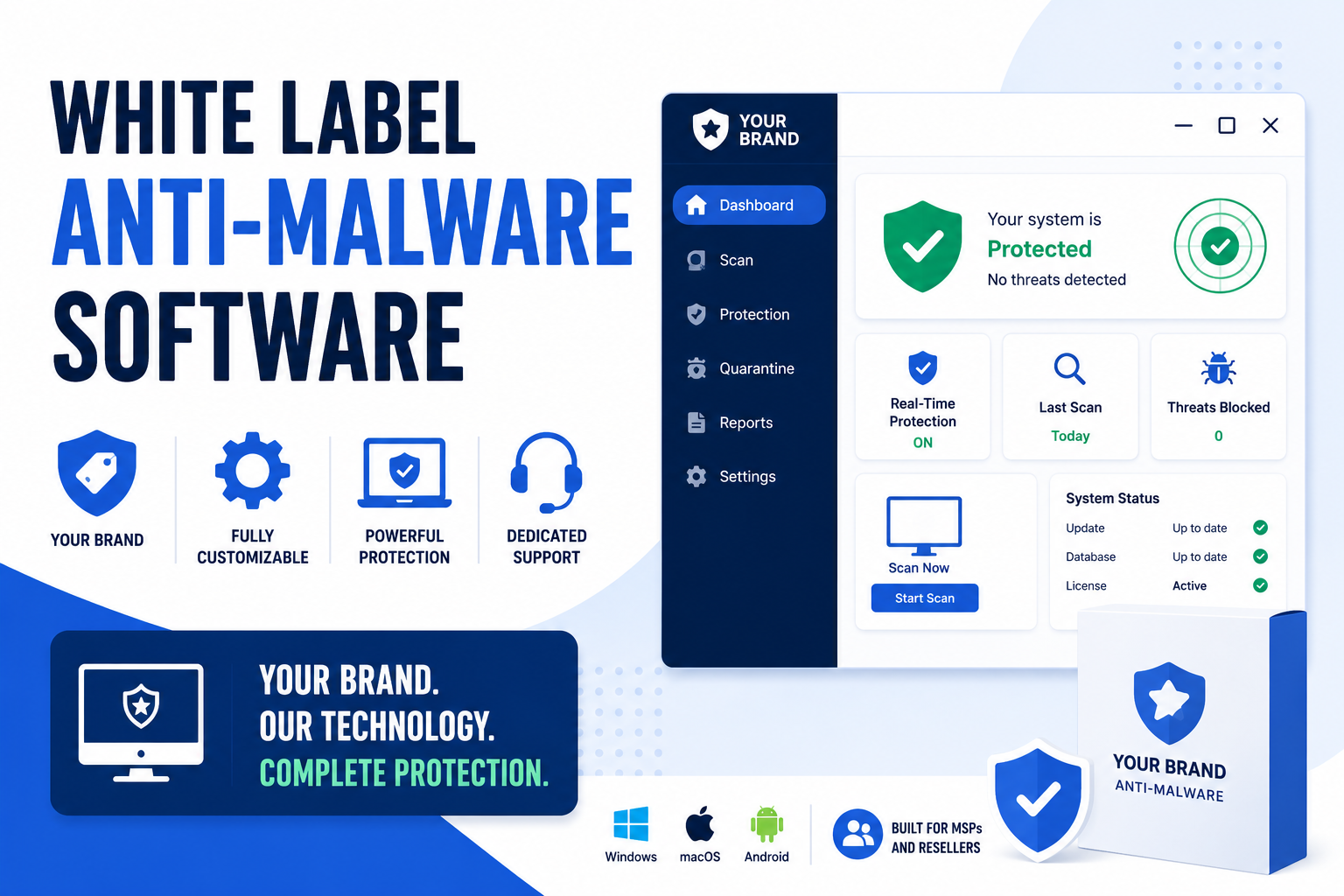
White Label Anti-Malware Software: What MSPs and ISVs Need to Know Before They Sign
If you're evaluating white label anti-malware software for your MSP, ISV, or hardware business, you've probably already noticed the pitch decks all sound the same: rebrand our engine, launch in weeks, own the margin. Some of that is true. Some of it depends heavily on which licensing model you pick and how much internal engineering time you're willing to spend on integration. This guide breaks down how white label anti-malware programs actually work, where the real costs sit, and how to tell a turnkey product from a raw SDK before you commit to a partner.
What Is White Label Anti-Malware Software?
White label anti-malware software is a fully built, independently maintained detection engine that a technology vendor licenses to a partner, who then rebrands it as their own product. The partner supplies the logo, product name, and colour scheme; the vendor supplies the detection logic, threat intelligence feed, and ongoing updates. End customers see your brand at every touchpoint and typically have no idea which company built the underlying engine.
This differs from straightforward reselling, where a customer buys a named third-party product (say, an established consumer suite) at a discount and your business appears only as a distributor. With white labeling, your name is the only one on the box.
White Label vs. OEM vs. Reselling — Where the Lines Actually Sit
These three terms get used almost interchangeably in vendor marketing, which causes real confusion during contract negotiation. In practice:
- Reselling means you sell someone else's branded product and earn a commission or margin. The end customer knows exactly whose software they're running.
- White labeling means the underlying vendor is invisible. You control the brand, pricing, and customer relationship end-to-end.
- OEM licensing is a broader umbrella that covers both scenarios, plus deeper cases where the engine is embedded inside a larger hardware or software product rather than shipped as a standalone app.
A hardware manufacturer pre-loading a rebranded scanner onto laptops is running an OEM deal that happens to be white labeled. A managed service provider billing clients monthly for "Acme Shield" is white labeling a security stack it never had to build. Both fall under the same general licensing category, but the contracts, support expectations, and technical scope differ.
How a White Label Anti-Malware Program Typically Works
Most providers, including our own partner programme, structure onboarding around a similar sequence: an initial discovery call to qualify the business case, a branding and licensing agreement, technical integration and QA, then launch. Where programmes diverge is in how much of that integration work falls on your team versus the vendor's.
| Option | Best For | Integration Effort | Typical Timeline |
|---|---|---|---|
| Turnkey rebrandable product | Resellers, VARs, small MSPs | Low — mostly branding assets | 4–6 weeks |
| SDK / API integration | ISVs embedding detection into an existing app | Moderate to high — dev resources required | 6–12 weeks |
| MSP / OEM multi-tenant deployment | MSPs and hardware OEMs at scale | Moderate — console and tenant setup | 6–16 weeks depending on scope |
Turnkey products suit businesses that want to sell a finished application without touching code. SDK integration suits software companies bolting detection onto something they've already built. The MSP/OEM path adds a centralized, multi-tenant console so a single team can manage policy and reporting across hundreds or thousands of endpoints under one brand.
What's Actually Inside a Competitive Anti-Malware Engine
Before signing with any partner, check that the underlying engine covers more than signature-based scanning. Threats have moved well past simple virus definitions, and a white label product that only does pattern matching will struggle against modern ransomware and fileless attacks. Look for these baseline capabilities:
Detection & Response
Real-time scanning, AI-driven heuristic analysis for zero-day threats, sandbox isolation for suspicious files, and behavioral monitoring that flags keystroke logging or registry tampering rather than relying purely on known signatures.
Ransomware-Specific Protection
Automated rollback that restores encrypted files from shadow copies is increasingly a baseline expectation, not a premium add-on. Given how expensive ransomware recovery gets without it, this is worth confirming in writing rather than assuming.
Management & Compliance
MSPs and OEMs in particular should confirm the console supports multi-tenant policy management, and that compliance reporting (GDPR, HIPAA, ISO 27001, SOC 2, depending on your client base) can be generated and branded under your own name.
Independent industry comparisons of white label security platforms consistently point to the same differentiators: detection accuracy under third-party lab testing, how deep the branding actually goes (some "white label" consoles still show the underlying vendor's logo in edge cases), and how much administrative overhead multi-tenant deployments add. It's worth asking any prospective partner directly how their product performs against those three criteria rather than taking a features list at face value.
What White Label Anti-Malware Actually Costs
Pricing varies by licensing model, and vendors are often vague about this until you're deep into a sales call. Three structures dominate the market:
- Per-seat annual licensing — you pay a flat rate per protected endpoint, typically billed annually with volume discounts at scale.
- Revenue-share — the vendor takes a percentage of what you charge end customers instead of a flat license fee, which lowers upfront cost but caps your margin ceiling.
- Flat-rate OEM licensing — a fixed fee structure common with hardware manufacturers pre-installing software on devices at volume.
Ask any vendor for pricing at your actual expected volume rather than published list rates, since most white label programs are quoted case-by-case. Also confirm whether "no minimums" claims apply only to the license fee or whether onboarding, integration support, and certification testing carry separate charges.
Who Should — and Shouldn't — White Label Anti-Malware
White labeling makes the most sense for businesses that already have a customer relationship and distribution channel but no security engineering team. Managed service providers billing recurring fees, software vendors wanting to bundle protection into an existing suite, and device manufacturers who need security pre-installed all fit this pattern well.
It makes less sense for a business planning to compete purely on price against major consumer brands with no differentiated service layer attached, since margins on commoditized security products are thin without support, monitoring, or bundling to justify a premium. A closer look at what buyers actually weigh when comparing vendors is covered in our anti-malware buying guide, and it applies just as much to what you should demand from a white label partner as to what an end customer expects from you.
Questions to Ask Before You Sign
A short checklist worth working through on any discovery call:
- Is the engine independently tested by AV-TEST, AV-Comparatives, or an equivalent lab, and can you see recent results?
- What exactly is included in "full rebranding" — installer, UI, support phone number, documentation, mobile apps?
- Who owns the customer relationship and billing if the partnership ends?
- What's the actual SLA for critical vulnerability patches and new threat signature updates?
- Does the multi-tenant console support the compliance reporting your specific client base needs?
Getting clear answers to these before you sign avoids the most common source of white label buyer's remorse: discovering mid-contract that "full rebranding" didn't include the support line your customers call.
Frequently Asked Questions
What is white label anti-malware software?
It's a complete, independently built anti-malware engine that a vendor licenses to a business, which then rebrands it under its own logo, product name, and UI. The end customer only ever sees the reseller's brand.
How much does white label anti-malware software cost?
Costs vary by model: per-seat annual licensing, revenue-share arrangements, or flat-rate OEM deals. Published per-device figures in the low single digits per year appear across several vendors, but actual pricing depends heavily on volume and which features are bundled in.
Is white label anti-malware profitable for MSPs?
It can be, particularly as a recurring subscription line item bundled with existing managed services. Profitability depends on your license cost relative to what clients will pay, and on whether you're adding enough support value to justify pricing above a bare-bones commodity rate.
What's the difference between white label and OEM anti-malware licensing?
White labeling specifically means the underlying vendor stays invisible to end customers. OEM licensing is the broader legal and commercial framework that white label deals typically sit inside, and it also covers cases where the engine is embedded in hardware or another software product rather than shipped as a standalone rebranded app.
Do end customers know the anti-malware product isn't built in-house?
With a properly implemented white label deal, no. The installer, UI, update mechanism, and support documentation should all carry your branding with no references to the underlying vendor visible to the customer.
How long does it take to launch a white label anti-malware product?
Turnkey rebrandable products typically launch in four to eight weeks. SDK integrations and deep OEM deployments with custom console work usually run longer, often eight to sixteen weeks depending on scope.
Do I need my own threat research team to offer white label anti-malware?
No — that's the core value proposition. The licensing vendor maintains the detection engine, signature database, and threat intelligence feed. Your team handles branding, sales, billing, and first-line customer support.
Can white label anti-malware software be integrated into an existing product via API?
Yes, for vendors offering an SDK path. This typically means C++, C#, .NET, or REST API access so detection, quarantine, and remediation functions can be embedded directly into software you've already built, rather than shipping a separate standalone application.
Does white label anti-malware include independent lab certification?
This varies by vendor and is worth confirming directly rather than assuming. Ask whether the underlying engine holds current AV-TEST or AV-Comparatives certification and whether that certification transfers to your rebranded product or needs to be re-run separately.
What happens to my customers if I switch white label anti-malware vendors later?
This depends entirely on contract terms, so it's worth negotiating upfront. Confirm data portability, whether existing installations need a full reinstall to migrate engines, and who owns the customer contact list if the partnership ends.
Where This Fits If You're Already Comparing Vendors
If ransomware exposure is a major part of your pitch to prospective clients, it helps to understand what recovery actually costs without rollback protection in place — our breakdown of ransomware recovery costs is a useful reference point when building your own sales materials. And for a wider look at detection gaps that matter beyond ransomware specifically, see our piece on what a trojan actually does once it's on a device, published by our technical support partner Devtaastic.
Ready to Explore a White Label Partnership?
DT Malware Safe's white label programme gives ISVs, MSPs, and OEMs full access to an enterprise-grade detection engine, AI heuristics, and a 100% rebrandable interface, with launch support built in from day one. Request a demo to see the engine, console, and licensing options in detail.
Need help with installation or ongoing computer support for your own team? Devtaastic offers dedicated computer support services that pair well with a new security rollout.